Are Your Labs Normal, But You Don't Feel Normal?
You go to the doctor. You ask questions. They run bloodwork. And then you get the call: everything looks normal
But you're exhausted in a way that sleep doesn't fix. Your brain feels like it's running through static. Your mood shifts without warning. Your body doesn't respond the way it used to. Something is clearly off — and yet, you're told you're fine.
If that sounds familiar, you're not alone. And you're not crazy.
This is one of the most common things Brittany Miles, Family Nurse Practitioner and co-owner of Luke's Well Co in Scottsburg, IN, hears from the women who come to her. She recently sat down with the Momstrosity Podcast to talk about exactly this — why so many women feel dismissed by traditional healthcare, what their symptoms might actually be pointing to, and what a different kind of care can look like. You can listen to the full episode here.
Why "Normal" Doesn't Always Mean Okay
Standard lab panels are designed with a single goal: ruling out disease. If your numbers fall within the reference range, you're told you're fine and sent on your way.
The problem is that "within range" and "optimal" aren't the same thing. And the way hormones are tested matters enormously — something most conventional appointments never address.
As Brittany explained on the podcast, hormone levels fluctuate throughout the month. Testing at the wrong time in your cycle can make things look normal when they're not. She's also a strong advocate for Dutch testing — a comprehensive urine test that doesn't just check hormone levels, but how your body is actually breaking them down and which pathways it's using. "I will live and die on Dutch testing," she said. "It tells us so much."
Her own PCOS went undiagnosed for years. Standard blood panels came back normal. It wasn't until she saw a functional medicine practitioner who tested her hormones correctly — at the right time, using the right method — that she finally got answers.
What This Can Look Like in Real Life
There's no single picture of someone whose labs look fine but who feels anything but. But some patterns come up again and again in Brittany's practice.
It might look like fatigue that doesn't respond to rest. Not tired-after-a-long-week tired, but a bone-deep exhaustion that makes a trip to the store feel like a full day's effort. As Brittany put it: "We're taught as women that fatigue is normal. It's not."
It might look like brain fog — losing words mid-sentence, walking into a room and forgetting why, feeling like you're thinking through a delay.
It might look like mood shifts that feel disconnected from what's actually happening in your life. Anxiety that seems to come from nowhere. A low-grade sense that something is wrong that you can't quite explain to anyone else.
It might look like weight that changes without a clear reason, heavy or irregular periods, joint inflammation, digestive issues that flare without an obvious trigger, or hair and skin changes that your doctor attributes to stress or aging.
None of these things, on their own, will necessarily show up on a standard panel. But all of them are worth taking seriously.
Why So Many Women Feel Dismissed
Brittany is direct about this: part of the problem is systemic.
"Lack of education around female health is one of the biggest things," she said on the podcast. Medical training covers hormones minimally. Insurance dictates what can be tested and how long a provider has with each patient — sometimes as little as seven minutes. In that window, there's no room to dig into the kind of nuanced, connected picture that functional medicine requires.
The result is that symptoms get managed rather than understood. A bad period becomes a birth control prescription. Anxiety becomes another medication. Each symptom gets its own band-aid, and no one asks why it's there in the first place.
"I don't fault the practitioners," Brittany said. "We don't know any better. And that's the most frustrating part."
It's also worth noting: Vitamin D deficiency alone can drive fatigue, mood issues, brain fog, and bone loss — and Brittany said roughly 80% of patients she tests come back below optimal levels, with some coming in as low as a 6. "How are you functioning?" she said. It's one of the first things she checks.
What Functional Medicine Does Differently
Functional medicine starts with a question that traditional healthcare rarely has time to ask: why is this happening?
At Luke's Well, that process begins with a real conversation — a comprehensive intake that covers your full health history, your symptoms, and what's been dismissed or overlooked before. From there, Brittany uses advanced testing like Dutch hormone testing, GI-MAP for gut health, comprehensive thyroid panels (not just TSH — T3, T4, and sometimes reverse T3), iron and ferritin levels, cortisol, and Vitamin D. Testing is chosen based on what your specific picture points toward, not a generic checklist.
What comes out of that is a personalized care plan built around root causes — whether that's hormone imbalances, gut dysfunction, nutrient deficiencies, inflammation, thyroid issues, or lifestyle factors. And it doesn't stop there. Follow-up visits track your progress, adjust the plan, and keep the work moving forward.
"I can promise you this," Brittany said. "I will listen. I will care and advocate for your health alongside you. How you feel matters."
A Note on Gut Health and Hormones
One thing that surprises a lot of people: your gut and your hormones are more connected than most providers ever mention.
If your digestion is sluggish, your body holds on to excess estrogen it should be clearing out. That can show up as heavy periods, breast tenderness, weight retention, and mood changes. Brittany touched on this on the podcast — getting things moving matters more than people realize, and it's one of the first lifestyle pieces she addresses with patients.
Nutrition plays a role too. Processed sugar, nutrient-depleted food, and the absence of quality whole foods all create a hormonal environment that makes symptoms worse. It's not about perfection — it's about understanding the connection and making small, meaningful changes over time.
What You Can Do Right Now
Brittany's advice from the podcast, simplified:
Advocate for yourself. You know your body better than anyone. If something feels wrong, keep pushing until someone takes it seriously. "If your provider isn't listening to you, go find another one."
Ask for more specific testing. A standard hormone panel during the wrong phase of your cycle isn't going to tell you much. Ask about timing. Ask about Dutch testing. Ask about ferritin, not just iron. Ask about T3 and T4, not just TSH.
Start with small changes. You don't have to overhaul everything at once. Reduce plastics where you can. Look at what you're putting on and in your body. Clean up your supplements — quality matters more than quantity. Move toward whole foods, even incrementally.
Get your Vitamin D checked. Seriously. Almost everyone in Indiana is deficient, and the impact is broader than most people realize.
Frequently Asked Questions
My doctor says I'm healthy. Why would I consider functional medicine? Standard care is designed to identify and treat disease. Functional medicine is designed to understand the whole person — including imbalances and patterns that don't meet the threshold for a diagnosis but are clearly affecting how you feel. The two aren't mutually exclusive.
How is hormone testing done at Luke's Well? Brittany uses Dutch testing — a comprehensive urine test that checks hormone levels, how your body metabolizes them, cortisol, melatonin, and more. Testing timing and method matter enormously, and she accounts for both.
Is functional medicine only for women? Brittany's primary passion is female hormones and women's health, but functional medicine at Luke's Well addresses a range of health concerns. If you're not sure whether it's a fit for what you're dealing with, a consultation is the right place to start.
What does an initial consultation cost? Initial consultations are $300 and cover a comprehensive visit to establish care, review your history, and begin building a personalized plan. Follow-up visits are $165.
Do I have to be local to Scottsburg? Luke's Well is right off I-65, making it easy to get to from Louisville, Jeffersonville, and surrounding counties. As Kelsey from the Momstrosity Podcast put it — it's worth the drive.
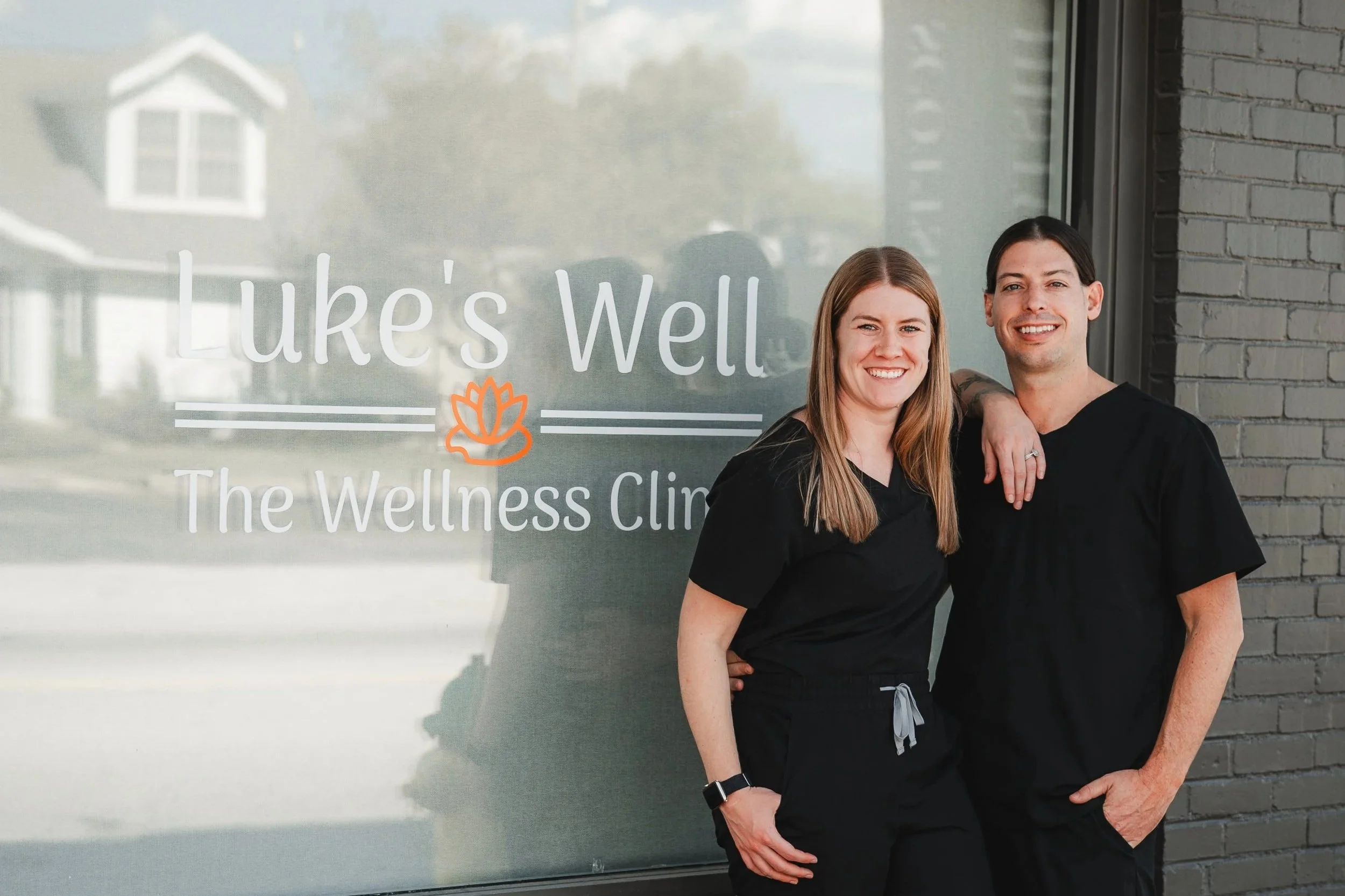
You're Not Crazy. You Just Haven't Had the Right Conversation Yet.
Brittany is currently accepting new functional medicine patients at Luke's Well Co in Scottsburg, IN. If you've been dismissed, passed around, or told everything looks fine when it doesn't feel that way — come in and let's actually look at what's going on.
Call or text us at (812) 595-7967 to get started.
🎙️ Listen to Brittany's full conversation on the Momstrosity Podcast
Medical suitability required. Results vary. This blog is for informational purposes only and is not intended as medical advice. Results vary. Medical suitability required.